
I chose to do the media diary assignment on the Saturday of my birthday weekend, mostly because that was the only time I knew I would be able to properly keep track of my consumption throughout the entire day. Luckily for me, I slept in and had a very active day, so the amount of media I consumed overall was pretty limited. However, the content I did take in turned out to be particularly interesting (especially compared to the usual, repetitive flow of viral video clips).
11:30am: I woke up and checked Facebook. The first post on my feed was from a member of my dashers for DoorDash group:
“RICH PEOPLE STAY RICH BY LIVING LIKE THEY’RE BROKE. POOR PEOPLE STAY BROKE BY LIVING LIKE THEY’RE RICH.”
Out of toxic habit, one which I am (forever) trying to break, I immediately checked the comment section and was not disappointed. There were several “OK, Boomer.” comments, with a few paragraphs of long-winded U.S. history lessons, touching on housing insecurity, the systemic oppression of poor people, and even the on-going COVID-19 pandemic sprinkled across the thread. Having just read Ayn Rand I was itching to chime in, but resorted to liking a few comments pointing out the problems with the poster’s simplified reasoning.
1:30pm: I read and reposted an NPR article about a new Barbie doll made in the likeness of Madam CJ Walker.
1:35pm: I watched and reposted a video of a person who made a song inspired by a facebook argument.
7:00pm: A friend told me about an app called Replika AI, that is essentially a robot friend. Supposedly, some users have reported that interacting with the app helps anxiety. I immediately typed the app’s name into the Google and clicked on this Medium article.
9:00pm: I went to karaoke and listened to colorful renditions of old-school classics and modern hits until the day turned over.
I waited until the following morning to review my previous day’s media consumption. At first glance, I was relieved because I felt that I’d recorded a surprisingly light day of intake; unfortunately, my thoughts of a quick-and-easy analysis were fleeting.
The Facebook post I started my log with is inarguably controversial, but it is also serves as perfect example for several logical fallacies. The poster suggested false cause in making a blanket statement: rich people stay rich by living frugally, while poor people stay poor because they live frivolously. This thinking is black-and-white. In the city I live in, one could easily see that the large encampments, some which take up stretches of several blocks, are filled with displaced individuals and not tech moguls. This isn’t to say that having poor spending habits or a lack of financial literacy aren’t factors in certain instances of poverty, but they are far from the only reason, which is what the Facebook post suggests.
The most questionable media I consumed turned out to be the one that was seemingly the least polarizing– the Facebook-argument-inspired song. I decided to first fact-check to see if the argument had really happened. A quick search on the Google for some of the song’s lyrics brought me to the original Facebook argument post, which went viral in 2020. Below is the first screenshot from that post.
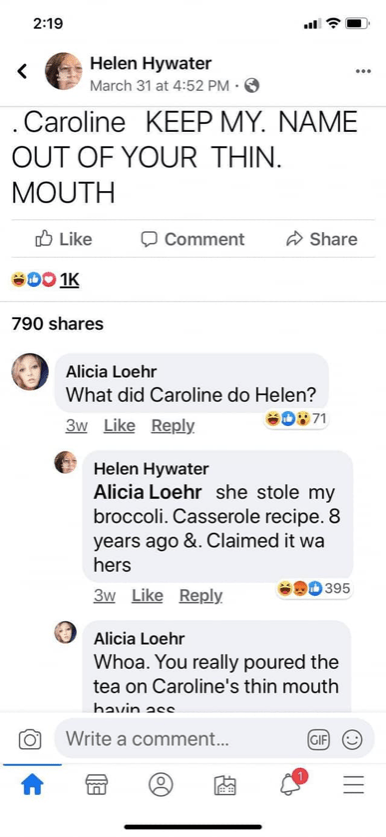
With the original poster and commenters’ full names in hand, I was able to do a search for their actual profiles. I learned that the names in the argument are all linked to real facebook profiles, but it is unclear if these profiles are connected to real people. While the stolen broccoli casserole recipe may not be controversial in the way that I expected the media I consumed to be, it proved to feel relevant to the topic of misinformation. Whether Helen Hywater is a real person or an imagined person doesn’t matter nearly as much as whether or not real people believe that Helen Hywater is a real person.
I’ve noticed the presence of fake social media profiles since I made my first AOL instant messaging (AIM) account in 2003. I’d come across a list of celebrity screen names, who you could supposedly add to your friends list, giving users instant access to some of their favorite superstars, so long as they were online. I remember messaging “Paris Hilton” and getting back quick responses that I could have only described as feeling robotic. These celebrity chatbots were my first experience with AI robots that are essentially impersonating a fellow user on a social media platform. Looking across the social media landscape today, we can see that these bots have clearly evolved. They seem to have taken on darker personas, often appearing in news articles and research articles about their use for accessing sensitive information and creating (additional) chaos in politics.
Much like bots, internet trolls are known for causing chaos and spreading misinformation. These trolls can be bots, but they can also have real people behind them. Some of these trolls are simply looking for laughs, but others (like the Russian “troll farm” Internet Research Agency) are looking to stir up trouble and sway the public’s opinion. While the Helen Hywater account, if fake, seems to be one that is looking to start a laughing attack rather than a riot, it is still a symptom of this age of misinformation. Satire and parody can be misinformation if they are accepted as truth, and the great broccoli casserole recipe controversy is a comical reminder of this reality.
Replika AI turned out to be less interesting than I hoped it would be. I ultimately didn’t feel like I could determine how safe the information recorded by the application truly is. So, I turned my attention back to the real world and went to consume some live media–karaoke at my favorite local lounge.
Overall, this diary reminded me that not only can the media itself we consume be deceptive or misinformed, but also that the source of that media can be an illusion of its own. One thing is for certain–I can already tell from this first assignment, that traveling across the world of media is going to be just as enlightening as traveling across North America.
 Wandering Woman