
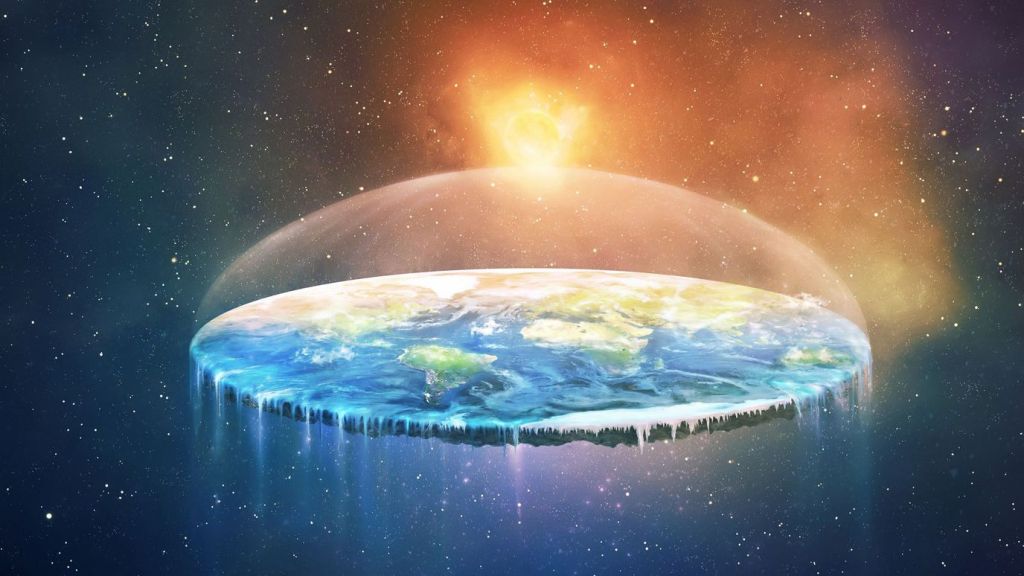
Had I not met one, I probably wouldn’t have ever believed they exist. Something like a mythical creature in my mind, a unicorn, a fairy— I’ve always held a spark of imagination that allowed for the possibility of such things, but this one was much harder to wrap my head around. How could somebody living in the 21st century truly believe the earth is flat?
A while back I went on a date with a guy that left me feeling confused and unsettled. Initially, I was impressed by the way he articulated himself and the old soul in me recognized immediately that chivalry seemed to come naturally to him. As we pulled up to my house at the end of the night, a spark of curiosity took ahold of me and I invited him inside. We sat talking for some time and I could feel butterflies, the first sign of a crush, fluttering below my chest. The conversation was blowing my mind and then he said, “You know…I’m not like other guys.” What! Did he really just say that? Without even considering a more creative angle? He’s not like other guys, now my mind was really blown. But don’t hold your breath, this isn’t a story from my collection of “me too’s”. This is about another conversation I’ve been having with anybody who will listen: what is The Truth?
This guy, who grew up in the same liberal-minded, knowledge-valuing community in the San Francisco Bay Area that I did, spent the rest of the evening attempting to educate me on The Truth About The Flat Earth. He told me that he’d spent hours on YouTube and had internet proof that we’ve been lied to about the true shape of our planet. He’s not like other guys because he doesn’t believe “the same bull sh*t story” we’ve been taught in school. I began to think hard about what motivates us to believe in something. Could I really blame him for thinking the earth is flat?
A teacher once told my grade-school class, “You are so lucky to be living in the Information Age. The Digital Revolution is happening right now!” The statement sounded powerful and stuck in my mind, but at the time I was just happy to be playing typing games and Oregon Trail during “Computer Hour”. Technology has made advancements over the past 25 years that are hardly believable in retrospect.
In recent years, humans have gained the ability to spread information like a virus. Each person that receives it may pass it on to a million more if they have the power to do so. I know I’m guilty of sharing a convincing article, only to later discover that it was all imagined by a pseudonym who could have rather had an incredible career as a fantasy novelist. Our minds are so easily manipulated by the overload of information we are constantly receiving. When a story is shared or “liked” by several of our friends, it’s easy to hop on with the hype and forget that what’s popular isn’t always what’s real.
Conspiracy theories and pseudoscience have become normalized in this Age of Information. As incredible advancements have been made in science and technology over the past several decades, movements have grown to resist them. “Flat Earthers” share a battlefield with Anti-Vaxxers, a seemingly less-extreme group of conspiracists (or, at least seemingly pre-Covid). But both groups deny the progress and proof of science, insisting that we are being lied to for a grander unknown reason. My mother’s older sister had friends die and become permanently disabled from Polio. Her generation remembers the clinic lines around the block, the excitement, gratitude, and sense of relief that came with the invention of the vaccine. Today, people rarely get polio in the United States. So what motivates us to believe in something? What proof is proof enough of the truth?
I am not ashamed to say that I dated the Flat-Earther several more times, and ultimately learned that his criticisms of science came from a deeper feeling of distrust. He is a Black man and feels that the information we have been told our whole lives has been from a white perspective with colonist motivations, one which we (POC, especially Black people) in America should know better than to trust. To bring up integration, Civil Rights and countless POC professionals and researchers was useless because the argument was always made that they are “part of the facade”. It seems that distrust and fear tend to be at the root of belief in conspiracy and the spread of mis/disinformation.
I think the best way to combat misinformation is to get to the root of the problem, but convincing the public to be trusting and unafraid in a country that was built upon the oppression of many of those living in it is not so easy. The fears many citizens have are valid, whether or not the threat truly remains. This valid fear is what must be addressed, but how?
 Wandering Woman