
As a major fan of games, this week’s blog post assignment had me hyped from the moment I read it: Play and evaluate two of the three hyperlinked “news games”. If you know me, you know I played all three. Several times.
The first game listed is called Bad News. I won’t go into too much detail about it because it was my least favorite of the three. The game runs in a chatbot format (possibly ironically, possibly not), where you are prompted to give one of two answers. One answer generally expresses uncertainty or moral objections to the creation and spread of fake news, while the other is far more sinister and always in agreement with the chatbot’s questionable intentions. The main issue I have with Bad News is that the chatbot ultimately pushes you into playing its game, whether you really want to or not. Here are some examples:
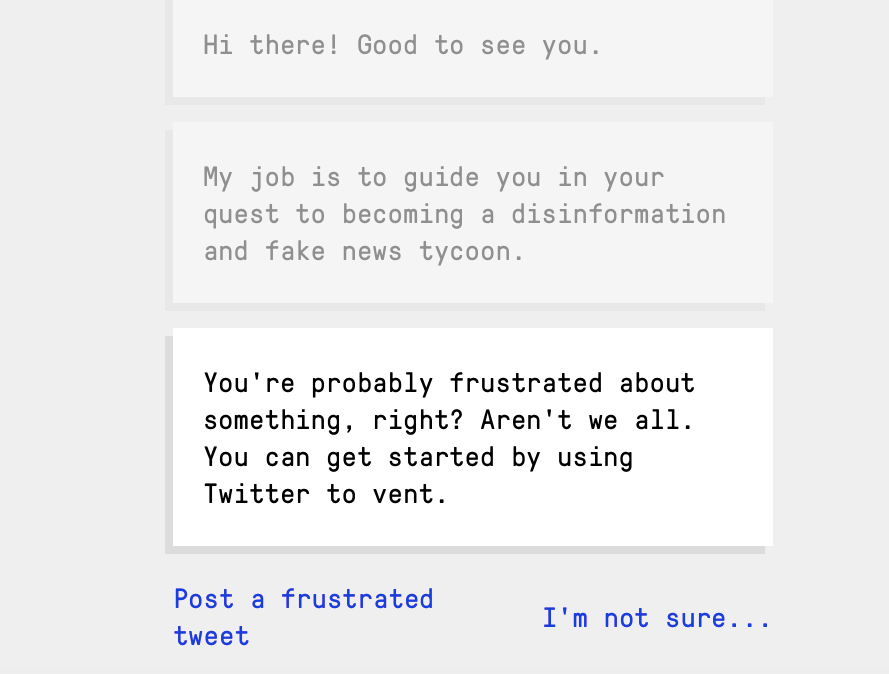
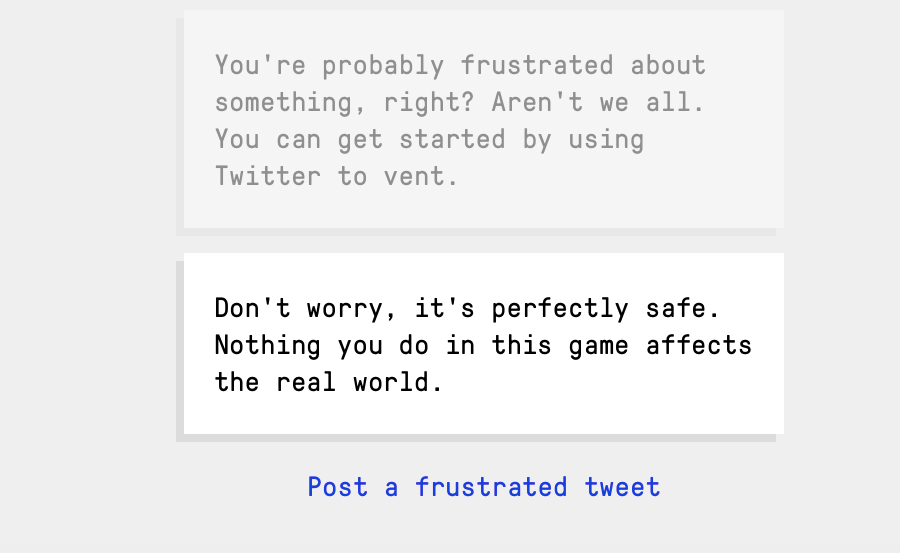
As you can see, regardless of the player’s uncertainty, the chatbot insists that you play along with its mischievous plan. When I selected “I’m not sure”, the robot pressured me into doing it anyway. This made me feel that the game doesn’t really reflect a typical experience with misinformation. It shows players how easy it is to create and spread fake news by taking them through six tactics: impersonation, emotion, polarization, conspiracy, discrediting, and trolling; however, it doesn’t seem to give players much of a “WHY”, but rather, a “HOW” fake news happens.
That being said, I felt that Fake It To Make It did a great job of providing players with both a how and why fake news is created and spread. The game allows players to exploit click-bait, making “money” off of article clicks and shares on social media. The game starts by explaining that the information itself matters less than its popularity, and that people who want to make money through monetizing media on the Internet don’t (and won’t) consider the truth or their own opinions when spreading it. Next, players are instructed to create their own news site. They are given an allowance of $50 to start their “business” with, told to choose a financial goal, and then given a task to complete, the first one being to create a website that has a credibility score of 30. Players then are taken through a process of selecting articles to copy and buying social media profiles, which will be used to plant the articles in groups. Articles are click-bait that either support or attack a fictitious political party (Orange v. Purple), or spread viral information like kid quotes and cat pictures. Players are tasked with figuring out where to plant these articles, so that they get the most clicks and shares, creating optimal revenue. After an hour or so, my game looked like this:
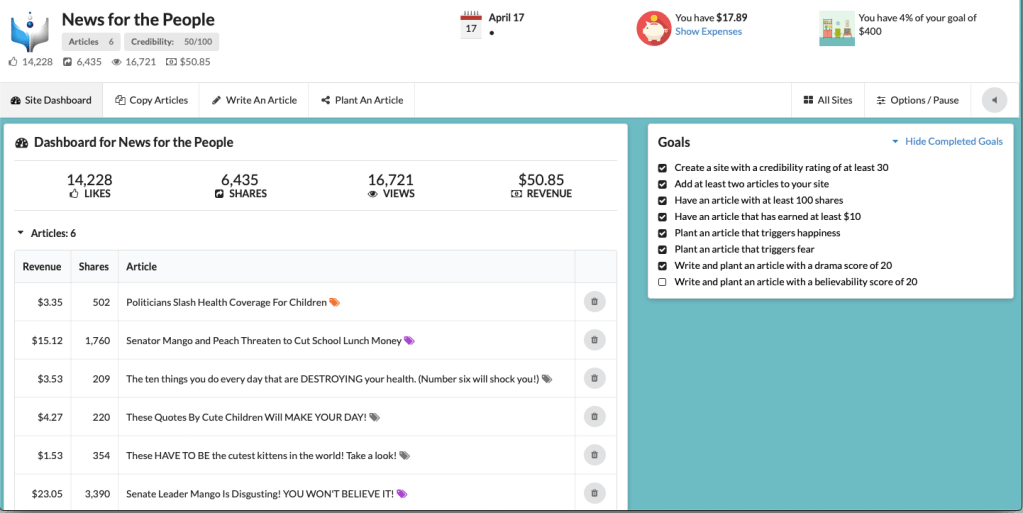
The list of goals on the right help to guide players in their strategy. Fake It To Make It is definitely the most complex and time-consuming of the games, but it also provides players with a broad understanding of the inner-workings of spreading information. The gameplay is saved as well, so that players can come back and continue building their business or start a new one. I think that this format makes the game ideal for middle and high schoolers, who may have the opportunity to gain media literacy as a part of their education. If children can learn both how and why information is spread, they will be better prepared to analyze it on their own.
The final game I played, Factitious, is the most straight forward. It allows users to select between six levels of difficulty (based on reading level), and then players dive into the gameplay. Articles are presented that the player must read and then decide whether they are real or fake news. I quickly learned that I could bypass the actual reading by checking the source at the bottom of the article:
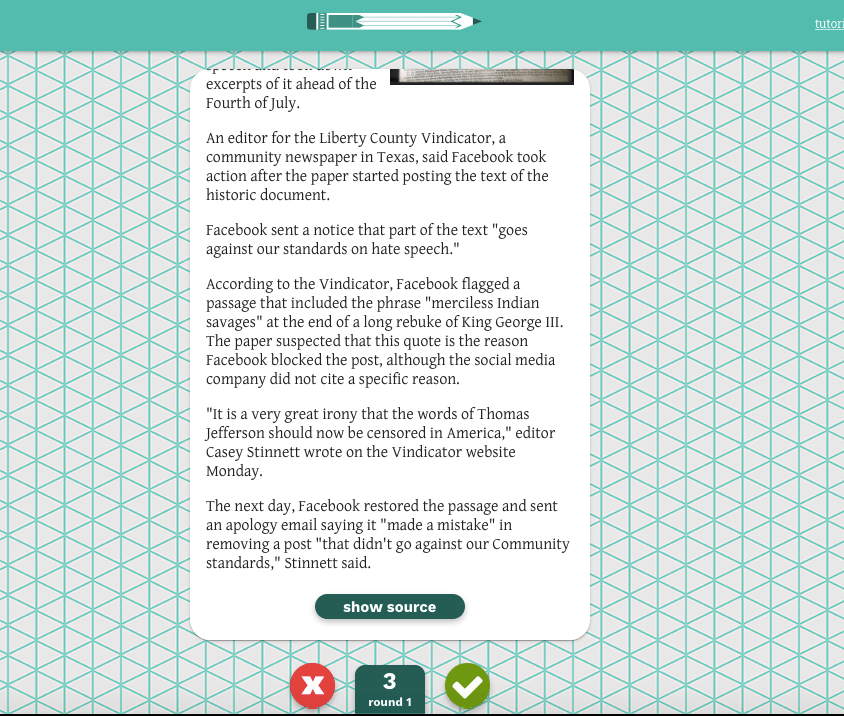
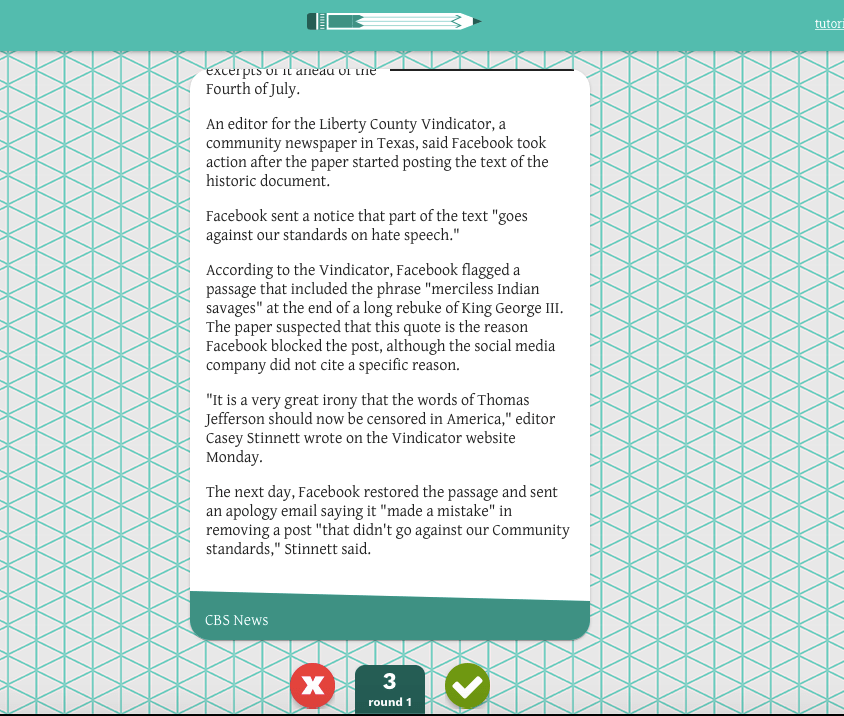
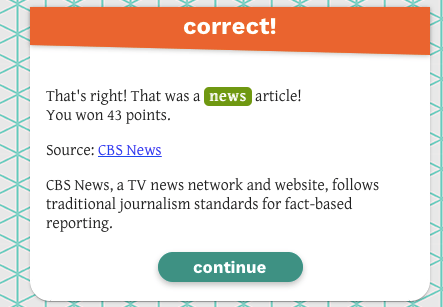
The pictured article was from CBS News, which I know is a fact-based news network. However, some of the articles come from international outlets and I couldn’t determine whether or not they were real without doing the reading. Regardless, Factitious is a simple game that allows players to exercise their analysis skills. It doesn’t explain the source or cause of misinformation in the way that Fake It To Make It does, but Factitious provides a private, judgement-free space to practice recognizing fact from fiction. This eliminates the shame or fear of embarrassment that some people may have when it comes to their ability to analyze information. This makes it ideal for all ages, and the fast gameplay suggests that it would make for a great lesson plan in an academic environment.
Overall, games seem to be a great way for people to explore the causes and effects of misinformation. I plan to share these with my colleagues at the writing center I work at, so that we can use them as tools when supporting students in sourcing evidence for their argumentative essays. These games reminded me of the educational games I played in the computer lab in grade school. Educational games helped me to memorize history, strengthen my arithmetic skills, and get my WPM up into the 80s (on a good day). They were an extremely successful tool for me. I believe that humans are highly receptive to play, and when it comes to misinformation, playing games could be our saving grace. Especially for future generations.
 Wandering Woman
Hi Elana,
Very well written article! I had no idea they had social media games like these.
Love,
Mom
LikeLike